ΕΞΑΙΡΕΤΙΚΟ
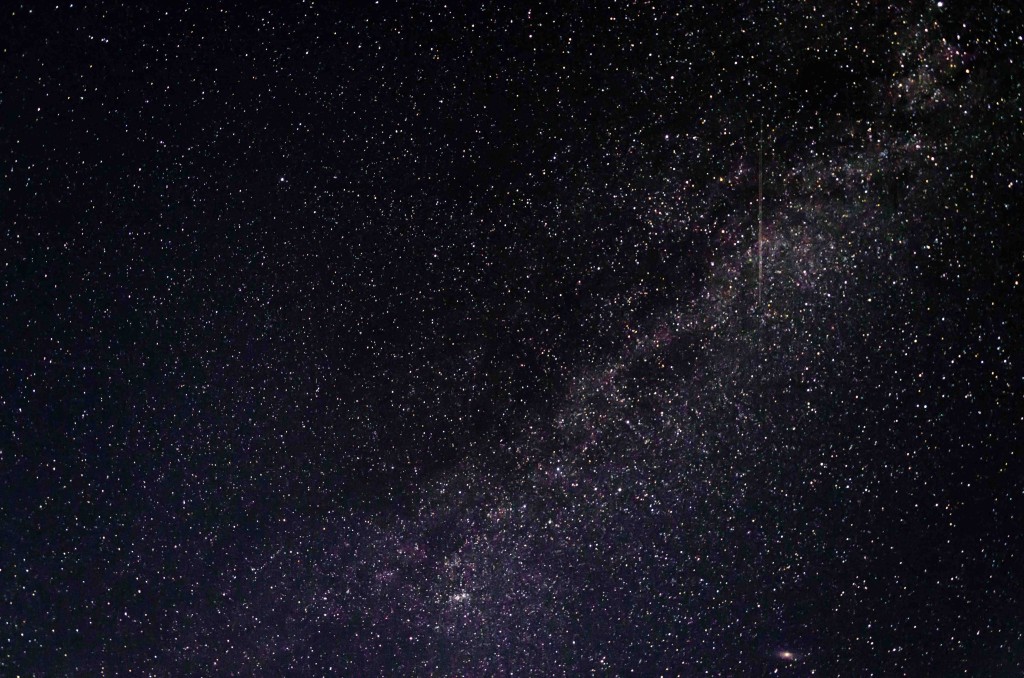
Everyone feels something when they're in a really good starry place on a really good starry night and they look up and see this:
Some people stick with the traditional, feeling struck by the epic beauty or blown away by the insane scale of the universe. Personally, I go for the old "existential meltdown followed by acting weird for the next half hour." But everyone feelssomething.
Physicist Enrico Fermi felt something too -- "Where is everybody?"
_________
A really starry sky seems vast -- but all we're looking at is our very local neighborhood. On the very best nights, we can see up to about 2,500 stars (roughly one hundred-millionth of the stars in our galaxy), and almost all of them are less than 1,000 light years away from us (or 1 percent of the diameter of the Milky Way). So what we're really looking at is this:
When confronted with the topic of stars and galaxies, a question that tantalizes most humans is, "Is there other intelligent life out there?" Let's put some numbers to it (if you don't like numbers, just read the bold)--
As many stars as there are in our galaxy (100 - 400 billion), there are roughly an equal number of galaxies in the observable universe -- so for every star in the colossal Milky Way, there's a whole
galaxy out there. All together, that comes out to the typically quoted range of
between 1022 and 1024 total stars, which means that for
every grain of sand on Earth, there are
10,000 stars out there.
The science world isn't in total agreement about what percentage of those stars are "sun-like" (similar in size, temperature, and luminosity) -- opinions typically range from 5 percent to 20 percent. Going with the most conservative side of that (5 percent), and the lower end for the number of total stars (1022), gives us 500 quintillion, or 500 billion billion sun-like stars.
There's also a debate over what percentage of those sun-like stars might be orbited by an Earth-like planet (one with similar temperature conditions that could have liquid water and potentially support life similar to that on Earth). Some say it's as high as 50 percent, but let's go with the more conservative 22 percent that came out of
a recent PNAS study. That suggests that there's a potentially-habitable Earth-like planet orbiting at least 1 percent of the total stars in the universe -- a total of
100 billion billion Earth-like planets.
So there are 100 Earth-like planets for every grain of sand in the world. Think about that next time you're on the beach.
Moving forward, we have no choice but to get completely speculative. Let's imagine that after billions of years in existence, 1 percent of Earth-like planets develop life (if that's true, every grain of sand would represent one planet with life on it). And imagine that on 1 percent of those planets, the life advances to an intelligent level like it did here on Earth. That would mean there were 10 quadrillion, or 10 million billion intelligent civilizations in the observable universe.
Moving back to just our galaxy, and doing the same math on the lowest estimate for stars in the Milky Way (100 billion), we'd estimate that there are 1 billion Earth-like planets and 100,000 intelligent civilizations in our galaxy.[1]
SETI (Search for Extraterrestrial Intelligence) is an organization dedicated to listening for signals from other intelligent life. If we're right that there are 100,000 or more intelligent civilizations in our galaxy, and even a fraction of them are sending out radio waves or laser beams or other modes of attempting to contact others, shouldn't SETI's
satellite array pick up all kinds of signals?
But it hasn't. Not one. Ever.
Where is everybody?
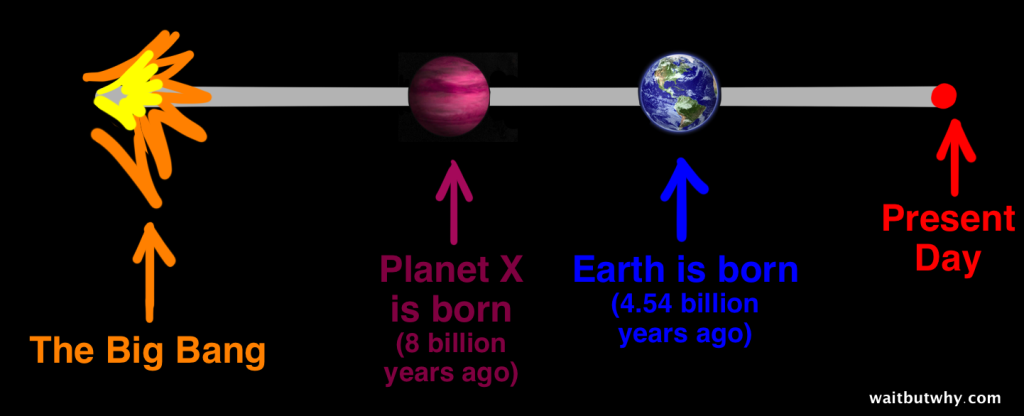
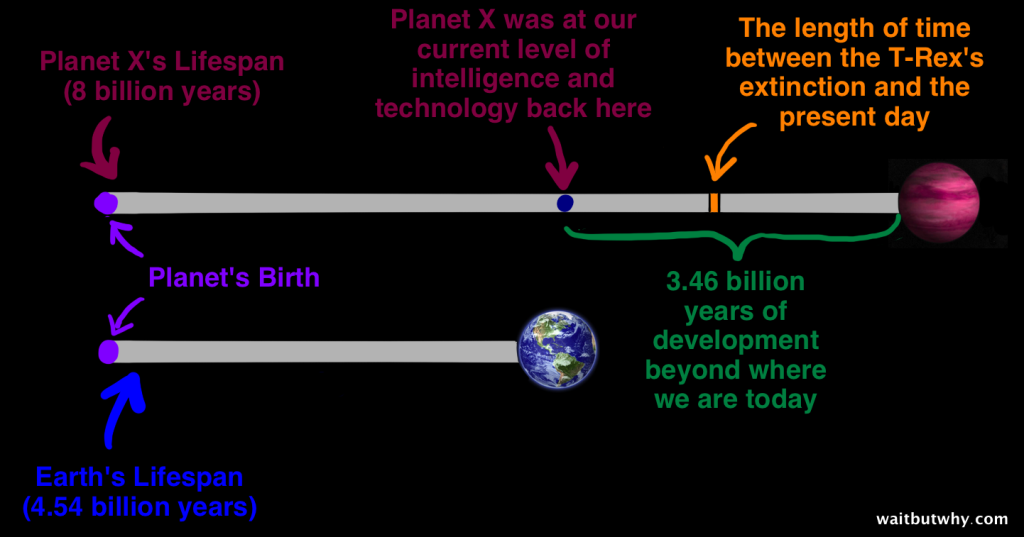
It gets stranger. Our sun is relatively young in the lifespan of the universe. There are far older stars with far older Earth-like planets, which should in theory mean civilizations far more advanced than our own. As an example, let's compare our 4.54 billion-year-old Earth to a hypothetical 8 billion-year-old Planet X.
If Planet X has a similar story to Earth, let's look at where their civilization would be today (using the orange time span as a reference to show how huge the green timespan is):
The technology and knowledge of a civilization only 1,000 years ahead of us could be as shocking to us as our world would be to a medieval person. A civilization 1 million years ahead of us might be as incomprehensible to us as human culture is to chimpanzees. And Planet X is 3.4 billion years ahead of us...
There's something called
The Kardashev Scale, which helps us group intelligent civilizations into three broad categories by the amount of energy they use:
A Type I Civilization has the ability to use all of the energy on their planet. We're not quite a Type I Civilization, but we're close (Carl Sagan created a formula for this scale which puts us at a Type 0.7 Civilization).
A
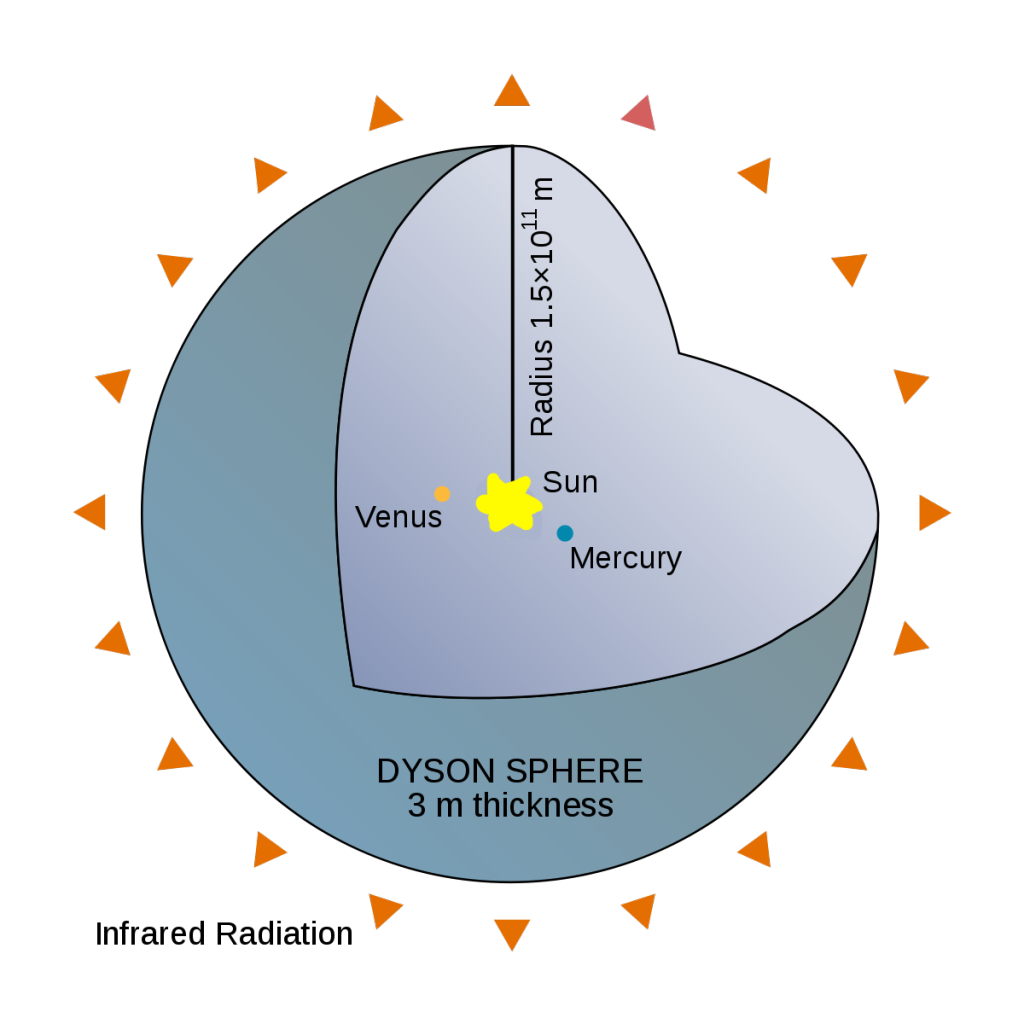
Type II Civilization can harness all of the energy of their
host star. Our feeble Type I brains can hardly imagine how someone would do this, but we've tried our best, imagining things like a
Dyson Sphere.
A Type III Civilization blows the other two away, accessing power comparable to that of the entire Milky Way galaxy.
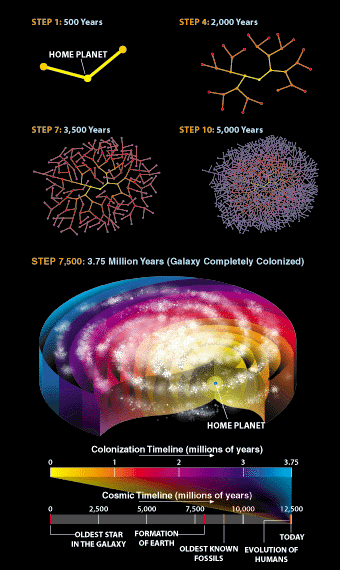
If this level of advancement sounds hard to believe, remember Planet X above and their 3.4 billion years of further development. If a civilization on Planet X were similar to ours and were able to survive all the way to Type III level, the natural thought is that they'd probably have mastered inter-stellar travel by now, possibly even colonizing the entire galaxy.
One hypothesis as to how galactic colonization could happen is by creating
machinery that can travel to other planets, spend 500 years or so self-replicating using the raw materials on their new planet, and then send two replicas off to do the same thing. Even without traveling anywhere near the speed of light, this process would colonize the whole galaxy in 3.75 million years, a relative blink of an eye when talking in the scale of billions of years:
Continuing to speculate, if 1% of intelligent life survives long enough to become a potentially galaxy-colonizing Type III Civilization, our calculations above suggest that there should be at least 1,000 Type III Civilizations in our galaxy alone -- and given the power of such a civilization, their presence would likely be pretty noticeable. And yet, we see nothing, hear nothing, and we're visited by no one.
So where is everybody?
_________
Welcome to the Fermi Paradox.
We have no answer to the Fermi Paradox -- the best we can do is "possible explanations." And if you ask ten different scientists what their hunch is about the correct one, you'll get ten different answers. You know when you hear about humans of the past debating whether the Earth was round or if the sun revolved around the Earth or thinking that lightning happened because of Zeus, and they seem so primitive and in the dark? That's about where we are with this topic.
In taking a look at some of the most-discussed possible explanations for the Fermi Paradox, let's divide them into two broad categories -- those explanations which assume that there's no sign of Type II and Type III Civilizations because there arenone of them out there, and those which assume they're out there and we're not seeing or hearing anything for other reasons:
Explanation Group 1: There are no signs of higher (Type II and III) civilizations because there are no higher civilizations in existence.
Those who subscribe to Group 1 explanations point to something called the non-exclusivity problem, which rebuffs any theory that says, "There are higher civilizations, but none of them have made any kind of contact with us because they all _____." Group 1 people look at the math, which says there should be so many thousands (or millions) of higher civilizations, that at least one of them would be an exception to the rule. Even if a theory held for 99.99 percent of higher civilizations, the other .01 percent would behave differently and we'd become aware of their existence.
Therefore, say Group 1 explanations, it must be that there are no super-advanced civilizations. And since the math suggests that there are thousands of them just in our own galaxy, something else must be going on.
This something else is called The Great Filter.
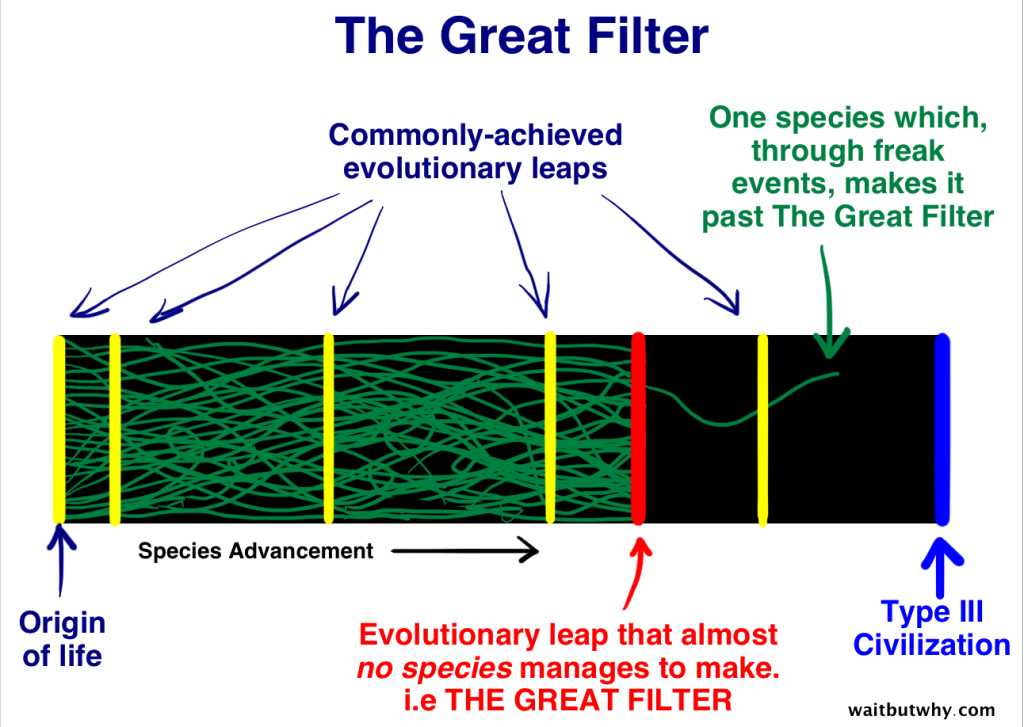
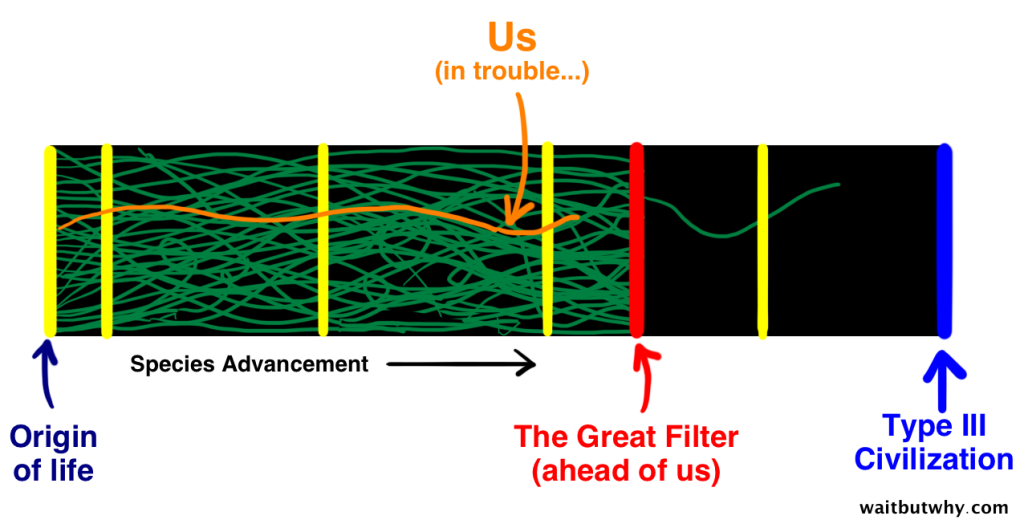
The Great Filter theory says that at some point from pre-life to Type III intelligence, there's a wall that all or nearly all attempts at life hit. There's some stage in that long evolutionary process that is extremely unlikely or impossible for life to get beyond. That stage is The Great Filter.
If this theory is true, the big question is, Where in the timeline does the Great Filter occur?
It turns out that when it comes to the fate of humankind, this question is very important. Depending on where The Great Filter occurs, we're left with three possible realities: We're rare, we're first, or we're fucked.
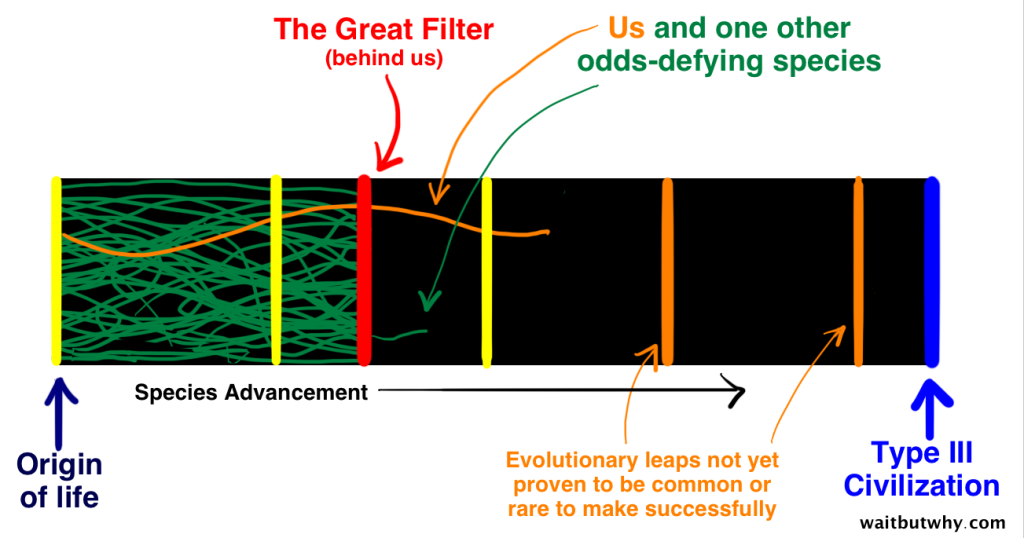
1. We're Rare (The Great Filter is Behind Us)
One hope we have is that The Great Filter is behind us -- we managed to surpass it, which would mean it's extremely rare for life to make it to our level of intelligence. The diagram below shows only two species making it past, and we're one of them.
This scenario would explain why there are no Type III Civilizations... but it would also mean that we could be one of the few exceptions now that we've made it this far. It would mean we have hope. On the surface, this sounds a bit like people 500 years ago suggesting that the Earth is the center of the universe -- it implies that we'respecial. However, something scientists call "observation selection effect" suggests that anyone who is pondering their own rarity is inherently part of an intelligent life "success story" -- and whether they're actually rare or quite common, the thoughts they ponder and conclusions they draw will be identical. This forces us to admit that being special is at least a possibility.
And if we are special, when exactly did we become special -- i.e. which step did we surpass that almost everyone else gets stuck on?
One possibility: The Great Filter could be at the very beginning -- it might be incredibly unusual for life to begin at all. This is a candidate because it took about a billion years of Earth's existence to finally happen, and because we have tried extensively to replicate that event in labs and have never been able to do it. If this is indeed The Great Filter, it would mean that not only is there no intelligent life out there, there may be no other life at all.
Another possibility: The Great Filter could be the jump from the simple prokaryote cell to the complex eukaryote cell. After prokaryotes came into being, they remained that way for almost two billion years before making the evolutionary jump to being complex and having a nucleus. If this is The Great Filter, it would mean the universe is teeming with simple prokaryote cells and almost nothing beyond that.
There are a number of other possibilities -- some even think the most recent leap we've made to our current intelligence is a Great Filter candidate. While the leap from semi-intelligent life (chimps) to intelligent life (humans) doesn't at first seem like a miraculous step, Steven Pinker
rejects the idea of an inevitable "climb upward" of evolution: "Since evolution does not strive for a goal but just happens, it uses the adaptation most useful for a given ecological niche, and the fact that, on Earth, this led to technological intelligence only once so far may suggest that this outcome of natural selection is rare and hence by no means a certain development of the evolution of a tree of life."
Most leaps do
not qualify as Great Filter candidates. Any possible Great Filter must be one-in-a-billion type thing where one or more total freak occurrences need to happen to provide a crazy exception -- for that reason, something like the jump from single-cell to multi-cellular life is ruled out, because it has occurred as many as
46 times, in isolated incidents, just on this planet alone. For the same reason, if we were to find a fossilized eukaryote cell on Mars, it would rule the above "simple-to-complex cell" leap out as a possible Great Filter (as well as anything before that point on the evolutionary chain) -- because if it happened on
both Earth and Mars, it's almost definitely not a one-in-a-billion freak occurrence.
If we are indeed rare, it could be because of a fluky biological event, but it also could be attributed to what is called the Rare Earth Hypothesis, which suggests that though there may be many Earth-like planets, the particular conditions on Earth -- whether related to the specifics of this solar system, its relationship with the moon (a moon that large is unusual for such a small planet and contributes to our particular weather and ocean conditions), or something about the planet itself -- are exceptionally friendly to life.
2. We're the First
For Group 1 Thinkers, if the Great Filter is not behind us, the one hope we have is that conditions in the universe are just recently, for the first time since the Big Bang, reaching a place that would allow intelligent life to develop. In that case, we and many other species may be on our way to super-intelligence, and it simply hasn't happened yet. We happen to be here at the right time to become one of the first super-intelligent civilizations.
One example of a phenomenon that could make this realistic is the prevalence of gamma-ray bursts, insanely huge explosions that we've observed in distant galaxies. In the same way that it took the early Earth a few hundred million years before the asteroids and volcanoes died down and life became possible, it could be that the first chunk of the universe's existence was full of cataclysmic events like gamma-ray bursts that would incinerate everything nearby from time to time and prevent any life from developing past a certain stage. Now, perhaps, we're in the midst of an
astrobiological phase transition and this is the first time any life has been able to evolve for this long, uninterrupted.
3. We're Fucked (The Great Filter is Ahead of Us)
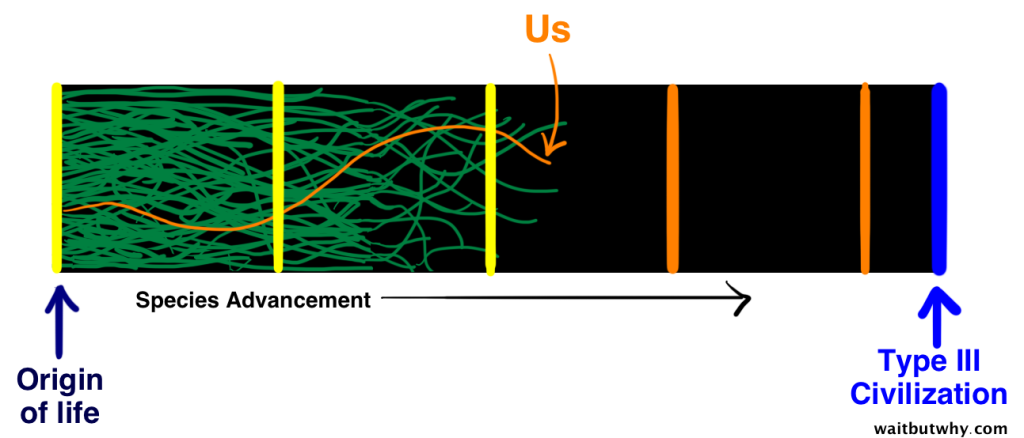
If we're neither rare nor early, Group 1 thinkers conclude that The Great Filter mustbe in our future. This would suggest that life regularly evolves to where we are, but that something prevents life from going much further and reaching high intelligence in almost all cases -- and we're unlikely to be an exception.
One possible future Great Filter is a regularly-occurring cataclysmic natural event, like the above-mentioned gamma-ray bursts, except they're unfortunately not done yet and it's just a matter of time before all life on Earth is suddenly wiped out by one. Another candidate is the possible inevitability that nearly all intelligent civilizations end up destroying themselves once a certain level of technology is reached.
This is why Oxford University philosopher Nick Bostrom
says that "no news is good news." The discovery of even simple life on Mars would be devastating, because it would cut out a number of potential Great Filters
behind us. And if we were to find fossilized
complex life on Mars, Bostrom says "it would be by far the worst news ever printed on a newspaper cover," because it would mean The Great Filter is almost definitely
ahead of us -- ultimately dooming the species. Bostrom believes that when it comes to The Fermi Paradox, "the silence of the night sky is golden."
Explanation Group 2: Type II and III intelligent civilizations are out there -- and there are logical reasons why we might not have heard from them.
Group 2 explanations get rid of any notion that we're rare or special or the first at anything -- on the contrary, they believe in the
Mediocrity Principle, whose starting point is that there is nothing unusual or rare about our galaxy, solar system, planet, or level of intelligence, until evidence proves otherwise. They're also much less quick to assume that the
lack of evidence of higher intelligence beings is evidence of their nonexistence -- emphasizing the fact that our search for signals stretches only about 100 light years away from us (0.1 percent across the galaxy) and suggesting a number of possible explanations. Here are 10:
Possibility 1) Super-intelligent life could very well have already visited Earth, but before we were here. In the scheme of things, sentient humans have only been around for about 50,000, a little blip of time -- if contact happened before then, it might have made some ducks flip out and run into the water and that's it. Further, recorded history only goes back 5,500 years -- a group of ancient hunter-gatherer tribes may have experienced some crazy alien shit, but they had no good way to tell anyone in the future about it.
Possibility 2) The galaxy has been colonized, but we just live in some desolate rural area of the galaxy. The Americas may have been colonized by Europeans long before anyone in a small Inuit tribe in far northern Canada realized it had happened. There could be an urbanization component to the interstellar dwellings of higher species, in which all the neighboring solar systems in a certain area are colonized and in communication, and it would be impractical and purposeless for anyone to deal with coming all the way out to the random part of the spiral where we live.
Possibility 3) The entire concept of physical colonization is a hilariously backward concept to a more advanced species. Remember the picture of the Type II Civilization above with the sphere around their star? With all that energy, they might have created a perfect environment for themselves that satisfies their every need. They might have crazy-advanced ways of reducing their need for resources and zero interest in leaving their happy utopia to explore the cold, empty, undeveloped universe.
An even more advanced civilization might view the entire physical world as a horribly primitive place, having long ago conquered their own biology and uploaded their brains to a virtual reality, eternal-life paradise. Living in the physical world of biology, mortality, wants, and needs might seem to them the way we view primitive ocean species living in the frigid, dark sea. FYI, thinking about another life form having bested mortality makes me incredibly jealous and upset.
Possibility 4) There are scary predator civilizations out there, and most intelligent life knows better than to broadcast any outgoing signals and advertise their location. This is an unpleasant concept and would help explain the lack of any signals being received by the SETI satellites. It also means that we might be the super naive newbies who are being
unbelievably stupid and risky by ever broadcasting outward signals. There's a debate going on currently about whether we should engage in METI (Messaging to Extraterrestrial Intelligence -- the reverse of SETI) or not, and most people say we should not. Stephen Hawking warns, "If aliens visit us, the outcome would be much as when Columbus landed in America, which didn't turn out well for the Native Americans." Even Carl Sagan (a general believer that any civilization advanced enough for interstellar travel would be altruistic, not hostile)
called the practice of METI "deeply unwise and immature," and recommended that "the newest children in a strange and uncertain cosmos should listen quietly for a long time, patiently learning about the universe and comparing notes, before shouting into an unknown jungle that we do not understand." Scary.[2]
Possibility 5) There's only one instance of higher-intelligent life -- a "superpredator" civilization (like humans are here on Earth) -- who is farmore advanced than everyone else and keeps it that way by exterminating any intelligent civilization once they get past a certain level. This would suck. The way it might work is that it's an inefficient use of resources to exterminate all emerging intelligences, maybe because most die out on their own. But past a certain point, the super beings make their move -- because to them, an emerging intelligent species becomes like a virus as it starts to grow and spread. This theory suggests that whoever was the first in the galaxy to reach intelligence won, and now no one else has a chance. This would explain the lack of activity out there because it would keep the number of super-intelligent civilizations to just one.
Possibility 6) There's plenty of activity and noise out there, but our technology is too primitive and we're listening for the wrong things. Like walking into a modern-day office building, turning on a walkie-talkie, and when you hear no activity (which of course you wouldn't hear because everyone's texting, not using walkie-talkies), determining that the building must be empty. Or maybe, as Carl Sagan has pointed out, it could be that our minds work exponentially faster or slower than another form of intelligence out there -- e.g. it takes them 12 years to say "Hello," and when we hear that communication, it just sounds like white noise to us.
Possibility 7) We are receiving contact from other intelligent life, but the government is hiding it. This is an idiotic theory, but I had to mention it because it's talked about so much.
Possibility 8) Higher civilizations are aware of us and observing us (AKA the "Zoo Hypothesis"). As far as we know, super-intelligent civilizations exist in a tightly-regulated galaxy, and our Earth is treated like part of a vast and protected national park, with a strict "Look but don't touch" rule for planets like ours. We wouldn't notice them, because if a far smarter species wanted to observe us, it would know how to easily do so without us noticing. Maybe there's a rule similar to the Star Trek's "Prime Directive" which prohibits super-intelligent beings from making any open contact with lesser species like us or revealing themselves in any way, until the lesser species has reached a certain level of intelligence.
Possibility 9) Higher civilizations are here, all around us. But we're too primitive to perceive them. Michio Kaku
sums it up like this:
Let's say we have an ant hill in the middle of the forest. And right next to the ant hill, they're building a ten-lane super-highway. And the question is "Would the ants be able to understand what a ten-lane super-highway is? Would the ants be able to understand the technology and the intentions of the beings building the highway next to them?
So it's not that we can't pick up the signals from Planet X using our technology, it's that we can't even comprehend what the beings from Planet X are or what they're trying to do. It's so beyond us that even if they really wanted to enlighten us, it would be like trying to teach ants about the internet.
Along those lines, this may also be an answer to "Well if there are so many fancy Type III Civilizations, why haven't they contacted us yet?" To answer that, let's ask ourselves -- when Pizarro made his way into Peru, did he stop for a while at an anthill to try to communicate? Was he magnanimous, trying to help the ants in the anthill? Did he become hostile and slow his original mission down in order to smash the anthill apart? Or was the anthill of complete and utter and eternal irrelevance to Pizarro? That might be our situation here.
Possibility 10) We're completely wrong about our reality. There are a lot of ways we could just be
totally off with everything we think. The universe might appear one way and be something else entirely, like a
hologram. Or maybe
we're the aliens and we were planted here as an experiment or as a form of fertilizer. There's even a chance that we're all part of a computer simulation by some researcher from another world, and other forms of life simply weren't programmed into the simulation.
_________
As we continue along with our possibly-futile search for extraterrestrial intelligence, I'm not really sure what I'm rooting for. Frankly, learning either that we're officially alone in the universe or that we're officially joined by others would be creepy, which is a theme with all of the surreal storylines listed above -- whatever the truth actually is, it's mindblowing.
Beyond its shocking science fiction component, The Fermi Paradox also leaves me with a deep humbling. Not just the normal "Oh yeah, I'm microscopic and my existence lasts for three seconds" humbling that the universe always triggers. The Fermi Paradox brings out a sharper, more personal humbling, one that can only happen after spending hours of research hearing your species' most renowned scientists present insane theories, change their minds again and again, and wildly contradict each other -- reminding us that future generations will look at us the same way we see the ancient people who were sure that the stars were the underside of the dome of heaven, and they'll think "Wow they really had no idea what was going on."
Compounding all of this is the blow to our species' self-esteem that comes with all of this talk about Type II and III Civilizations. Here on Earth, we're the king of our little castle, proud ruler of the huge group of imbeciles who share the planet with us. And in this bubble with no competition and no one to judge us, it's rare that we're ever confronted with the concept of being a dramatically inferior species to anyone. But after spending a lot of time with Type II and III Civilizations over the past week, our power and pride are seeming a bit David Brent-esque.
That said, given that my normal outlook is that humanity is a lonely orphan on a tiny rock in the middle of a desolate universe, the humbling fact that we're probably not as smart as we think we are, and the possibility that a lot of what we're sure about might be wrong, sounds wonderful. It opens the door just a crack that maybe, just maybe, there might be more to the story than we realize.


 Photo: Angeliki Panagiotou / Fosphotos.com
 Photo: Evelina @flickr